
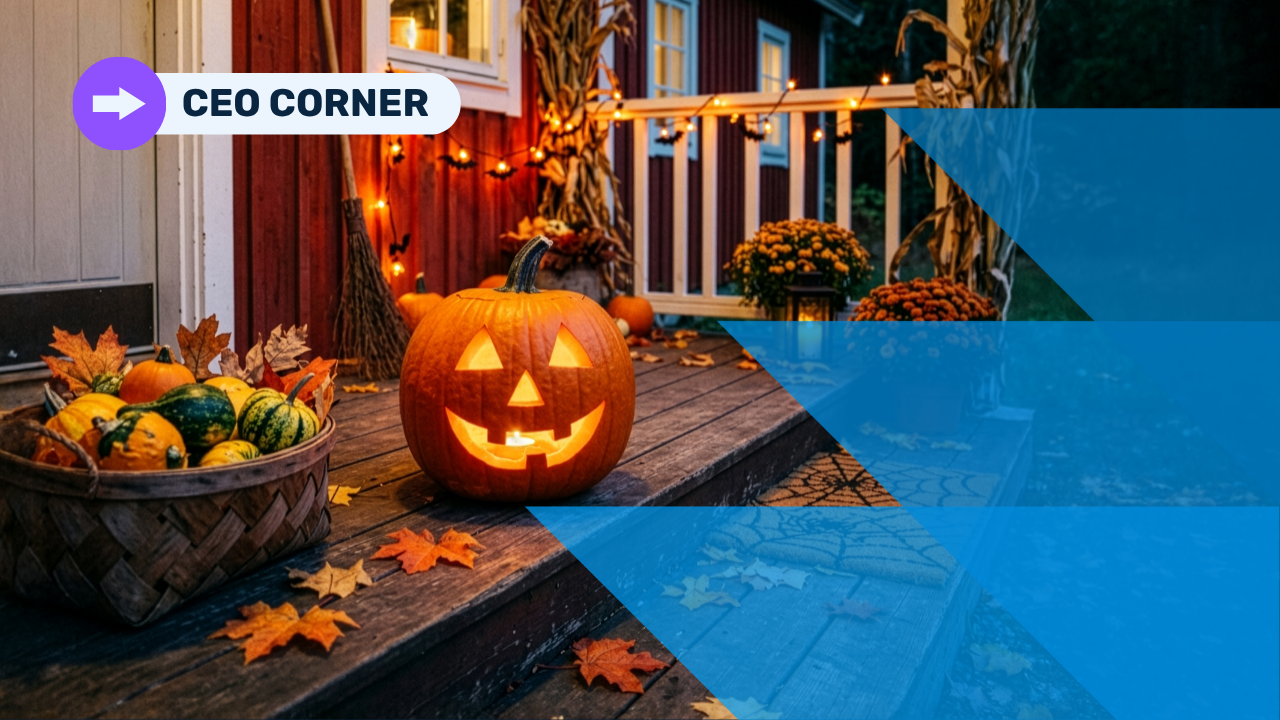
This Halloween, AI shopping agents are out trick-or-treating too. They only knock on doors they can see.
Every October 31st, millions of kids run the same algorithm. Porch light on: walk up. Porch light off: keep moving. Nobody stops to wonder whether the dark house is hiding full-size candy bars. A dark porch reads as closed, and closed gets skipped. This year Halloween lands on a Saturday, which means more kids, more hours on the sidewalk, and more porches judged in about half a second.
That little neighborhood ritual turns out to be a pretty good preview of how a lot of holiday shopping is about to work.
The new trick-or-treaters
A new kind of visitor is heading up the walk this season. Salesforce predicts that 20% of all holiday ecommerce traffic in 2026 will originate from AI chat agents. PwC found that 29% of consumers plan to use AI somewhere in their shopping journey this year, up from 22% last year. Amazon is even using its October Prime Big Deal Days to steer shoppers toward Alexa for Shopping.
These agents behave a lot like kids on Halloween. They're fast, tireless, and ruthlessly literal. Ask one to find trail runners in a size 10 that you can pick up today, and it won't care about your brand story or your beautifully merchandised store. It cares about three things: is the product in stock, where is it, and how fast can the shopper get it. If it can't answer those questions about you, it moves on to the next house.
Local isn't the problem. Visibility is.
Here's the frustrating part for specialty brands: shoppers still want local. In NRF's Halloween survey, specialty Halloween and costume stores draw 32% of shoppers, ahead of online sites at 27%. Looking at the full holiday season, Mastercard expects in-store sales to grow 3.6%, which would be the strongest showing for physical retail in four years.
So the candy is there. Your dealers have the inventory, the expertise, and the fitting bench. What many of them don't have is a porch light. Their stock lives in a point-of-sale system nobody outside the building can query. To a human browsing your website, that's an annoyance. To an AI agent, it's a dark house.
And agents don't knock twice. When the local option is invisible, the sale goes to whoever's data is cleanest and most complete. In most categories, that's the biggest marketplace on the block.
AI doesn't fix invisibility. It punishes it.
Most of the AI conversation in commerce right now is about what to buy: shopper bots, AI search, generated product copy, agentic checkout. Some of it will matter. But there's an unglamorous truth underneath all of it. AI is an amplifier. It makes visible things more visible and invisible things more invisible.
That means a brand with a strong retail network that nobody can see could watch AI shopping quietly route around it, sending demand its own dealers could have fulfilled to someone else entirely. The gap between brands with lit-up networks and brands with dark ones won't shrink with AI. It will widen.
This is a leadership call, not a software purchase
Turning the porch lights on takes decisions only leaders can make. What inventory data will your retail partners share, and how often? How do orders get routed to the nearest dealer who has the product? How does that dealer get paid and credited when they fulfill? Those are relationship conversations, not settings in a dashboard.
A useful test before your next AI budget meeting: can anyone outside the store see what your dealers have on the shelf right now? If a shopper (or a bot working for one) wants it today, can you send that order to the closest retailer automatically? And does that retailer have a good reason to want the order? If the answer to any of those is no, that's the place to start. It's cheaper than a chatbot, and it makes every AI tool you buy later work better.
Flipping the switch
This is exactly the problem Quivers was built to solve. Quivers connects brands to their retail network and surfaces retailer inventory that isn't otherwise publicly exposed, so a shopper on your site can see that the product they want is in stock ten minutes away. From there, BOPIS and Ship-from-Store turn that visibility into a sale your dealer fulfills and gets credit for.
The result is a network that's lit up instead of dark. Whether the shopper is a person on a phone or an agent working on their behalf, the porch light is on and the door is open.
The best house on the block isn't always the one with the biggest candy bars. It's the one that's easy to find. This season, flip the switch.
Curious how Quivers works? Take a tour. See how we can boost your commerce performance. Get A Demo.