
The early season read is one of the most trusted rituals in specialty sports. Reps check in. Accounts reorder or go quiet. Regional patterns start to emerge. By mid-April, most brand leaders have a working view of how the season is shaping up — and they're already using it to make decisions.
This is how it's always worked. That's not a compliment.
Here's the uncomfortable part: that picture is almost certainly incomplete. And the gap isn't where most people look for it.
The Signal You're Measuring Isn't the Same as the Demand You Created
The signals coming in right now — reorder patterns, rep feedback, regional variation — are real. They're telling you something genuine about how the season is opening.
But they're only measuring what made it all the way through. What converted, what reordered, what showed up in your data. They're not measuring the demand that formed and then dissolved before it reached a shop floor.
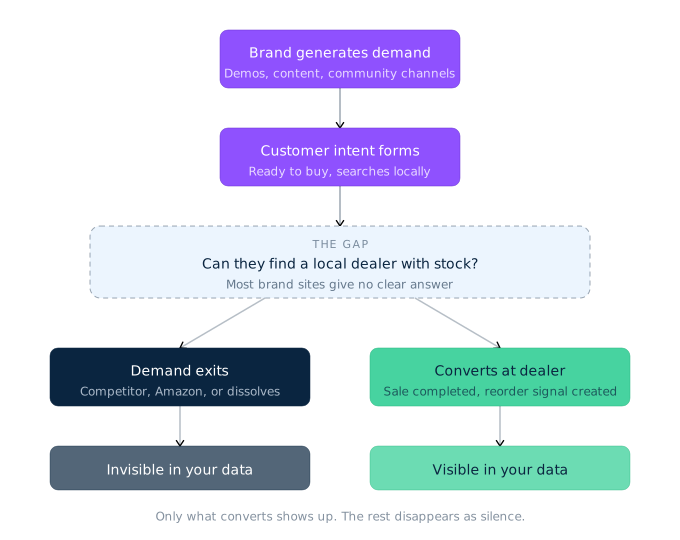
Customers are already moving. They've come off demos, watched content, heard about a product from someone they trust on the water or on the bank. The intent is real. And some of it is converting cleanly — the customer finds the right dealer, confirms stock, makes the trip, buys.
Some of it isn't converting. Not because the demand wasn't there. Because somewhere between interest forming and purchase completing, the path wasn't clear enough. They couldn't confirm who had it in stock nearby. The uncertainty wasn't worth the drive. The intent moved on — to a competing brand, to a big box, or just away entirely.
That part doesn't appear in your reorder data. It doesn't show up in rep feedback. The dealer who didn't get that visit has no record of it. The demand that dissolved before it reached a shop floor doesn't leave a trace — it just registers as silence.
Which is a very peaceful way to describe lost revenue.
And silence, in early season reads, tends to get filed under "soft market." It's a tidy explanation. It's also sometimes completely wrong.
Quiet Accounts Aren't Telling You What You Think They're Telling You
This is where the conventional wisdom starts to break down.
Most brands treat early season quiet as a signal about demand. A quiet account means low local interest. A quiet region means the market is soft. It's a reasonable assumption. It's also the one that quietly wrecks your June.
Quiet can mean low demand. It can also mean demand that formed, hit friction in the path to purchase, and went somewhere else. The account didn't reorder because the customer didn't arrive — not because the customer didn't want the product. Those are two very different problems. They look identical in your data.
The specialty retail demand gap that most summer sports brands aren't fully accounting for isn't a gap in demand generation. These brands are good at creating demand — through pro content, through demo events, through the community channels that drive this industry. The gap is in capture. The distance between the interest your brand generates and the in-store sell-through your dealer network actually records.
For a dealer-first brand, that gap is invisible by design. Your business model puts the conversion at the shop floor. When it happens, you see it. When it doesn't, you don't — and you don't know why.
Why Getting This Wrong in April Costs You in June
Early in the season, the incomplete picture is easy to absorb. The gaps are small. There's still time for things to develop. It feels manageable.
But the read you're forming right now is about to become your operating baseline for the next four months.
Quiet accounts get deprioritised. Soft regions get fewer rep visits. Products that generated real interest but lost customers in the handoff get flagged as underperformers. The decisions downstream — which dealers to push for mid-season reorders, where to direct rep effort before Memorial Day, which SKUs to get behind for the back half — all flow from the picture you're building today.
If that picture is missing a meaningful share of what's actually happening across your dealer network, the decisions aren't just incomplete. They're confidently wrong in ways that are hard to diagnose later. By the time the pattern becomes clear, peak season has passed and the best opportunity to act on it is gone.
What the Brands Getting This Right Are Asking Differently
The brands that catch this early aren't running bigger marketing programs or managing larger dealer networks. They're asking a harder question about the picture they're building.
Not just: what is selling?
But: of the demand we created this spring, how much of it actually made it to a dealer — and how would we know if some of it didn't?
The difference between those two questions is the difference between managing the season you can see and understanding the season that's actually happening. It's also the difference between a summer sports sell-in planning conversation built on last year's order data and one built on what genuinely moved through the market — by dealer, by region, by SKU — while the season was live.
That kind of dealer sell-through visibility doesn't come from rep feedback alone. It comes from connecting the demand your brand generates through its marketing and community channels to what's actually happening at the shop floor level, in real time, while there's still something you can do about it.
The Question Worth Asking Before Memorial Day
When you look at the early reads coming in right now — the reorder patterns, the rep calls, the regional signals — how much of that picture are you confident you're actually seeing?
The accounts that are reordering are telling you what converted. The accounts that are quiet are telling you much less than most brands assume.
There are about six weeks before the early season picture becomes the assumption that drives the rest of the year. That's the window where this is still worth looking at.
After that, you're not diagnosing the season. You're just finishing it.
Quivers connects specialty brands and their retail partners across every channel — so demand gets captured, dealers get found, and both sides learn from what's actually happening across the network.
Find Out More →