
NAMM 2026 Sent a Clear Signal: The DTC vs Dealer Debate Is Over
NAMM’s 125th anniversary had the energy you would expect. Big launches. Packed halls. Education sessions everywhere.
But the most important conversations were not happening on stage.
They were happening in the aisles between brand leaders and retailers circling a deeper question about where the industry is headed:
How do brands build direct relationships with customers without weakening the dealer network that built the industry?
For years, musical instrument brands have treated ecommerce as a strategic dilemma.
Sell direct and risk channel tension with dealers.
Stay wholesale-only and risk losing online market share.
That framing no longer holds.
The real constraint in 2026 is not demand. It is the logic of how to best leverage supply.
And the brands gaining ground are not choosing sides. They are redesigning how demand flows through their network.
Here are four structural shifts that kept surfacing across the show floor.
1. “Protect the Dealer” Is Not a Strategy. Orchestration Is.
Avoiding ecommerce does not protect dealers. It simply redirects demand to marketplaces and third parties where neither the brand nor the retailer wins.
Modern brands are changing what happens after digital intent appears.
Instead of forcing a choice between brand fulfillment and dealer fulfillment, they are routing online purchases into dealer inventory when it makes economic and geographic sense.
The result is structurally different:
The brand captures high-intent demand on its own site.
The local dealer fulfills from existing stock.
Inventory turns improve at retail.
The brand retains customer data and visibility.
Margin is preserved without undercutting partners.
When this works well, ecommerce stops behaving like a competing storefront.
The brand generates the traffic.
The dealer rings the register.
2. Your Dealer Network Is Already Forward-Deployed Inventory
Many MI brands at NAMM, especially international ones expanding in the U.S., are facing the same ceiling:
Strong demand.
Limited domestic infrastructure.
Capital tied up in centralized distribution.
The traditional answer is another warehouse. More fixed cost. More duplicated inventory. More risk.
The smarter answer is visibility.
When a brand can see real-time retail inventory across its dealer base, shelf stock becomes eligible ecommerce inventory.
This changes the math:
Less inventory duplication across nodes.
Faster local delivery without expanding footprint.
Better working capital efficiency.
Reduced stockouts in one region while overstock sits in another.
Dealer inventory is already in market.
The inventory was never the problem.
The visibility was.
3. The Static Dealer Locator Is a Revenue Leak
If your site still ends the customer journey with a list of addresses, you are not neutral.
You are leaking high-intent demand.
Musical instrument purchases are tactile and community-driven. But they are also digitally initiated.
When a shopper searches for a specific guitar, keyboard, or limited-run pedal, they want to know one thing:
Can I get it near me?
If the answer is “Here are some stores, good luck,” conversion drops. Often straight to a marketplace.
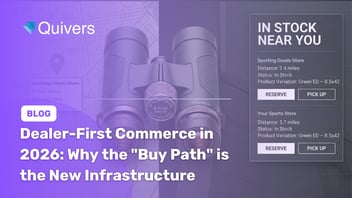
Brands modernizing this experience are replacing static dealer locators with live local availability.
That does three things immediately:
Keeps shoppers on the brand site.
Shows real inventory reality.
Converts digital demand into in-store sales, pickup, or local fulfillment.
Customers are not looking for directions.
They are looking for inventory.
4. The Single-Unit Bottleneck Is a Coordination Problem
Many MI manufacturers are optimized for pallet shipments and dealer replenishment cycles.
They are not optimized for single-unit parcel shipping to consumers.
That has led some brands to assume meaningful ecommerce expansion requires a warehouse overhaul.
It usually does not.
Retailers already ship single units every day. They have pick-and-pack operations, carrier accounts, returns workflows, and staff trained for it.
When integrated correctly, brand demand and retailer fulfillment complement each other:
The brand generates digital demand.
The dealer executes last-mile fulfillment.
Inventory velocity improves across the network.
The brand enters ecommerce without rebuilding its supply chain.
The infrastructure was already there.
It just wasn’t connected.
The Strategic Reality
NAMM 2026 made one thing clear.
The growth ceiling for many MI brands is often self-imposed.
When ecommerce, wholesale, and retail inventory operate on separate systems and separate assumptions, the result is predictable:
Capital tied up in the wrong inventory positions.
In-season revenue missed because visibility is limited.
Channel tension caused by blind routing decisions.
Demand lost to marketplaces that should have been captured on the brand site.
The brands solving this are not abandoning retail.
They are designing systems where digital demand and dealer inventory work together.
When demand generation, inventory visibility, and fulfillment routing align, the old DTC versus dealer debate becomes irrelevant.
The question shifts from:
“Should we sell direct?”
to
How intelligently are we routing demand through our network?
If ecommerce and wholesale teams are still operating off separate inventory and sales realities, the growth constraint is structural.
The brands that fix that layer will not just modernize.
They will outpace.
And in a market where attention is loud but margins are tight,
orchestration wins.

.png?width=352&name=Playbook%20Brand%20Dealer%20(4).png)